
Distribution & Legacy Case Study (ages 70+)
The Family Profile
Household: Male (Age 73) & Female (Age 73)
Retirement Status: Fully retired; living off a combination of Social Security benefits ($48,000 Male / $33,600 Female) and tax-deferred retirement account distributions.
Home & Real Estate: Primary residence in FL ($1.2M market value) owned free and clear.
The Goal: Active Tax Minimization, Legacy Preservation & Spending Confidence
Our primary focus for this stage is maintaining a smooth, predictable annual spending plan while actively managing required minimum distributions (RMDs), evaluating late-stage health protections, and tax-efficiently passing assets to children or grandchildren.
Lifetime Spending & Cash Flow Trajectory
Lifetime Spending & Cash Flow Trajectory
What The Chart Below Shows You:
Stable Discretionary Floor: Illustrates a consistent annual discretionary lifestyle spending level of $230,028 (in today’s dollars) sustained throughout every year of retirement.
Low & Stable Tax Overhead: Demonstrates how ongoing federal taxes remain predictable (~$56k–$62k) during standard retirement years, avoiding artificial tax bracket spikes.
Seamless Long Term Care Cost Absorption: Integrates a $300,000 (in today’s dollars) combined annual allocation for late-life care costs (Ages 97–100) without causing a forced reduction in baseline discretionary living standards. Of course this assumes the assumptions all play out according to plan - see below on ways to be more certain about funding these costs for the future.
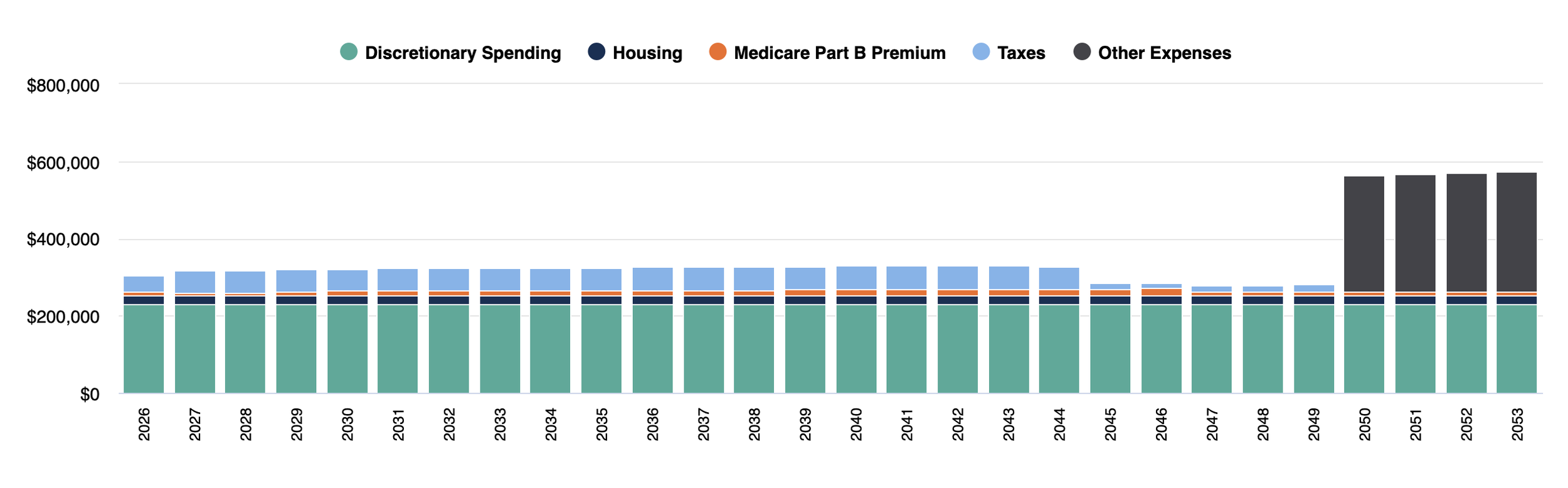
Granular Cash Flow Snapshots: Understanding the Inflection Points
Real financial security comes from understanding how money flows through different key phases of life.
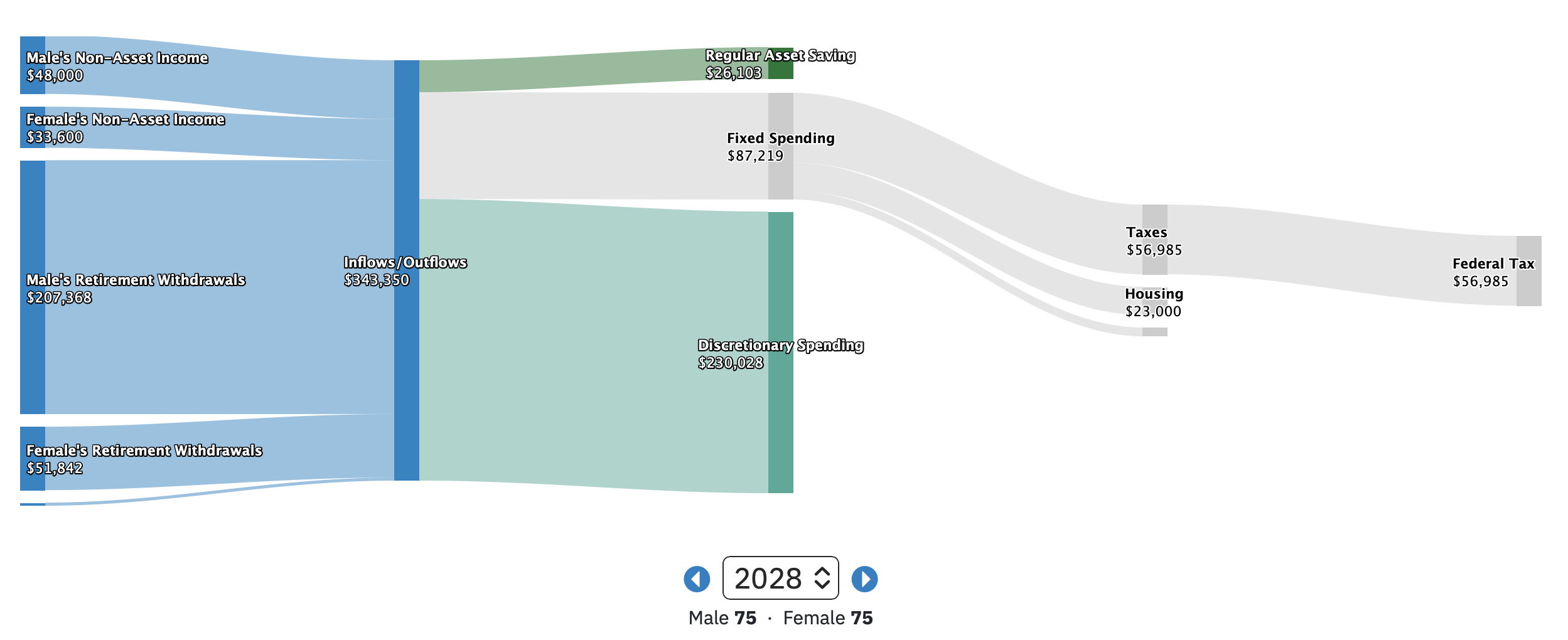
Typical Retirement Year (2028 — Male Age 75 / Female Age 75):
Inflows ($343,350): Guaranteed Social Security ($81,600 total) combined with scheduled IRA withdrawals ($207,368 Male / $51,842 Female).
Outflows: Fixed taxes ($56,985) and housing costs ($23,000) are fully covered, allowing $26,103 to be saved into regular taxable assets while preserving $230,028 in discretionary spending.
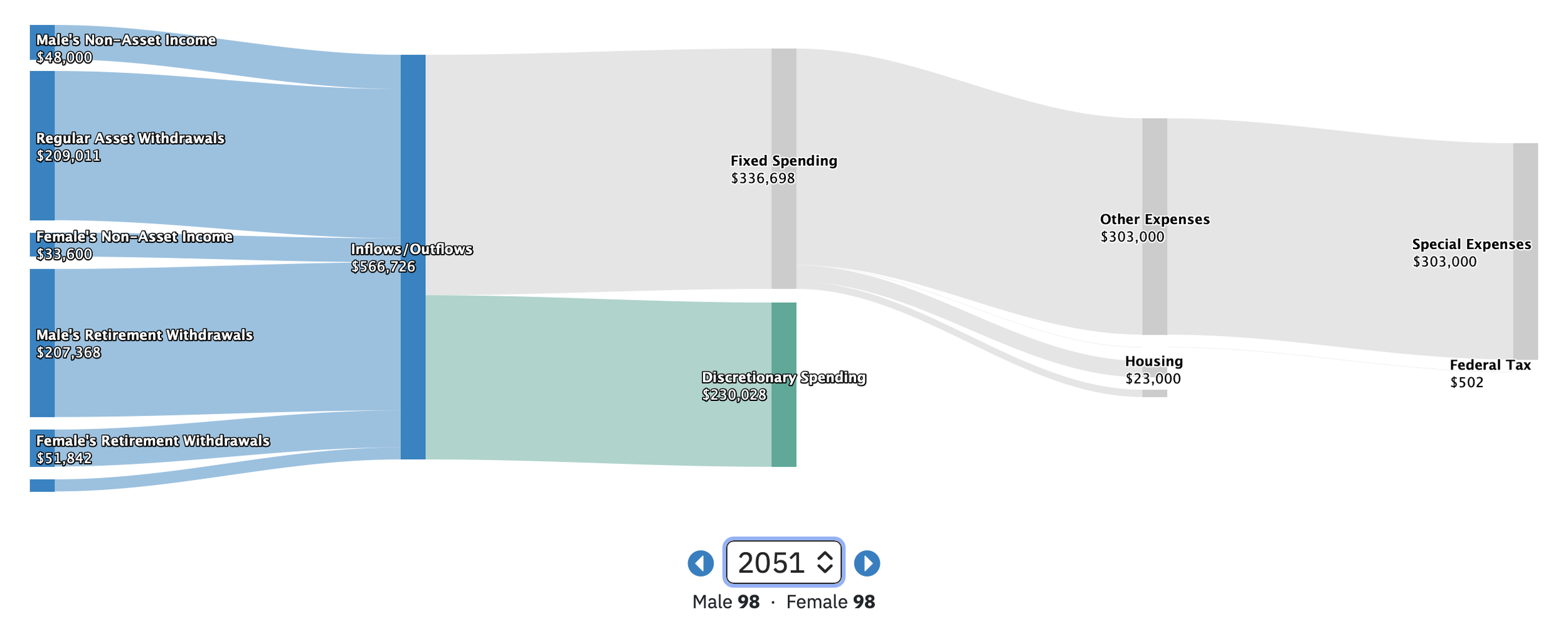
Late-Stage Long-Term Care Year (2051 — Male Age 98 / Female Age 98):
Inflows ($566,726): Social Security and IRA distributions supplemented by planned regular asset liquidations ($209,011).
Outflows: Seamlessly absorbs $303,000 in specialized healthcare/medical expenses while federal taxes drop to near-zero ($502), leaving baseline lifestyle spending intact.
Maximizing Discretionary Spending Through Strategic Timing
In your 70s, every tax-management strategy involves a distinct trade-off between current lifestyle flexibility and long-term tax reduction:
Targeted 8-Year Roth Conversion Strategy: Executing 8 consecutive years of partial Roth conversions in early retirement yields a net present value tax savings of $25,000 (~$1,200/year over a lifetime). While beneficial, it requires paying tax capital upfront.
Strict RMD Optimization (Deferral vs. Lifestyle): Delaying extra conversions and sticking strictly to standard RMD schedules can yield up to $122,000 in lifetime nominal savings. However, the trade-off is significant: during the first 9 years, annual discretionary spending is reduced by $30,000/year to fund taxes, in exchange for $32,000/year in higher spending over the final 19 years. For many families, sacrificing early-retirement lifestyle quality to gain tax wins in their 90s is simply not worth the trade-off.
Multi-Generational Legacy & QCDs: Utilizing Qualified Charitable Distributions (QCDs) directly from IRAs satisfies RMD mandates without triggering income tax spikes or Medicare IRMAA surcharges, while 529 gifting strategies allow surplus wealth to compound tax-free for grandchildren.
Enhancing Stability, Certainty, and Peace of Mind
Evaluating the Guaranteed Income Base:
In this baseline plan, guaranteed Social Security covers 25–30% of total annual retirement expenses. Because the remaining 70–75% relies on portfolio withdrawals, the spending floor is stable but major market downturns could add significant anxiety to you lives. 25-30% is at the low end of the Peace of Mind Index, suggesting that you may benefit from additional sources of guaranteed income (and sleep better during market downturns).
(Read more: Is Your Retirement Income Sleep-Proof?)
Protecting Against the Human Cost of Care:
As shown in the late-stage cash flow model, guaranteed income coverage drops further to roughly 15% of total annual cash needs during a late-life healthcare event. Utilizing a Qualified Longevity Annuity Contract (QLAC) or dedicated Long-Term Care Insurance shores up this differential for the later stages of the plan, preserving portfolio capital and shielding family inheritance from medical drain. But the financial drain is just the beginning - if you are not prepared for long term care, it could have a devastating impact on your loved ones that have to step in to care for you.
(Read more: Is Your Family Ready for the Human Cost of Caring for You?)